 Ultimate guide
The Fleet Manager's Guide to Preventative Maintenance
Last Updated: November 26, 2026
Quick Summary
Preventative maintenance for commercial truck fleets is scheduled inspection and service work performed at fixed intervals to catch wear before it becomes a breakdown. Commercial trucks typically require basic preventative maintenance every 10,000 to 15,000 miles, with the interval depending on the vehicle and operating conditions. Confirm the schedule against the manufacturer's guidance and your actual duty cycle before you set it in stone.
- Many fleets spend near $0.09 to $0.15 per mile on maintenance, often 20% to 30% of operating expenses.
- Group vehicles by duty cycle, not by make and model, to set base service intervals.
- Give every vehicle two triggers, mileage and calendar, and let whichever fires first drive the service.
- Target preventative maintenance compliance of 90% or better; below 80% means the schedule is being ignored.
- A commercial motor vehicle periodic inspection is required at least once every 12 months.
Table of Contents
- Why Preventative Maintenance Decides Whether Your Fleet Profits
- The Commercial Truck Preventive Maintenance Checklist
- How to Build a Fleet Maintenance Schedule That Fits Your Routes
- Setting Up a Truck Preventive Maintenance Program That Actually Runs
- Fleet Maintenance Records: The Paper Trail That Protects You
- Downtime vs. Maintenance: The Cost Math Fleet Owners Should Run
- Telematics and Condition-Based Maintenance for Smaller Fleets
- Booking Your Fleet's First Preventative Maintenance Visit
- Frequently Asked Questions
Why Preventative Maintenance Decides Whether Your Fleet Profits
Preventative maintenance for commercial truck fleets is scheduled inspection and service work performed at fixed intervals to catch wear before it becomes a breakdown.
The math is unforgiving. According to Fleetistics fleet cost estimates, many fleets fall near $0.09 to $0.15 per mile for maintenance, which commonly represents 20% to 30% of total operating expenses.
Preventative maintenance isn't a cost center, it keeps cost per mile predictable.
The Commercial Truck Preventive Maintenance Checklist
A commercial truck preventive maintenance checklist is the written list of inspections and service tasks your technicians perform at each interval. It converts "look the truck over" into a repeatable, auditable process.
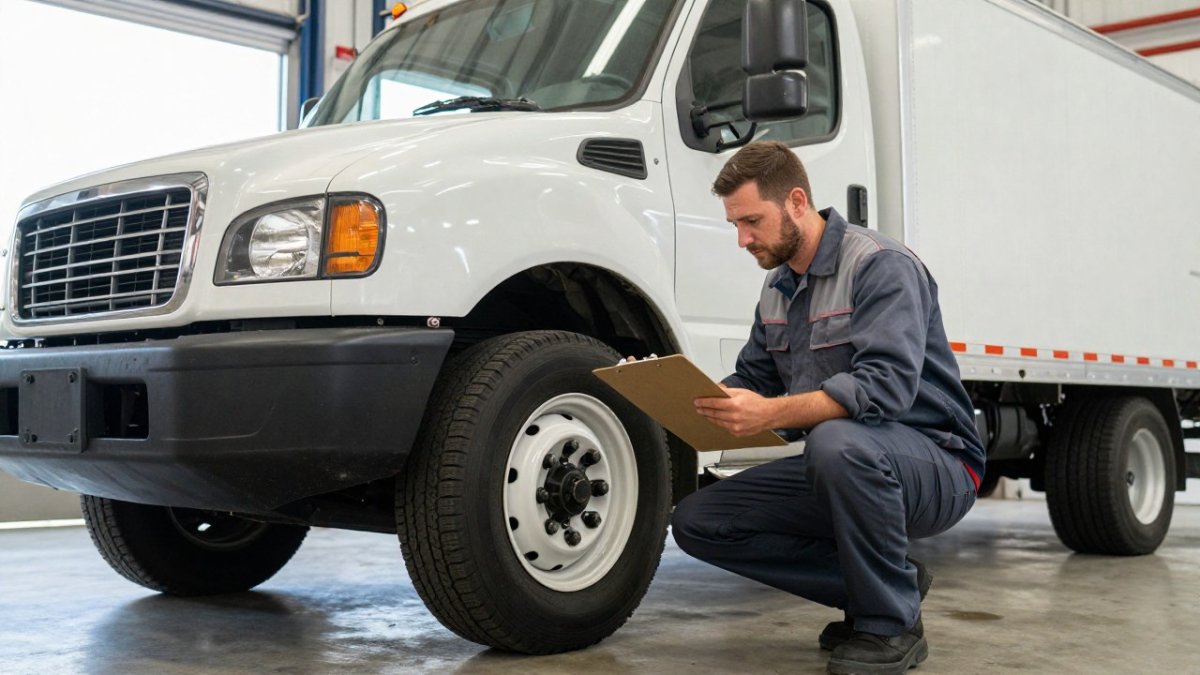
Commercial trucks typically require basic preventive maintenance every 10,000 to 15,000 miles, per Alliance Fleet Solutions maintenance guidance, with the interval depending on the vehicle and operating conditions.
Daily Pre-Trip and Post-Trip Inspections
The pre-trip inspection is the cheapest maintenance you will ever perform, catching low tires, leaks, and burned-out lights before they become roadside failures.
Your daily checklist should cover:
- Tire pressure and visible tread wear
- Fluid levels: coolant, brake fluid, oil, and washer fluid
- Brake feel and air pressure build-up
The post-trip inspection matters just as much: documenting an issue at day's end gives your shop a head start before the next dispatch.
Tires, Brakes, and Fluids
Tires show wear and tear first. Check pressure weekly, rotate on schedule, and watch for uneven tread wear that signals an alignment or suspension issue.
Brake inspection belongs in every routine service, not as an afterthought. Brake fluid absorbs moisture over time, air brake systems on heavy-duty vehicles need systematic checks, and coolant and lubrication fluid checks round out the core service items.
How to Build a Fleet Maintenance Schedule That Fits Your Routes
The right fleet maintenance schedule is built around your duty cycle, not a generic mileage chart. A truck running short urban delivery routes accumulates brake wear and stop-start stress a highway truck never sees.
Step 1: Group vehicles by duty cycle, not by make and model
Duty cycle is the pattern of work a truck performs: how far it runs, how often it stops, how much it idles, and how heavily it is loaded. Four groups cover most commercial operations:
- Local delivery and service, short routes, frequent stops, heavy brake and transmission cycling, low average speed
- Regional haul, 150 to 400 miles per day, mixed highway and secondary roads, moderate load variation
- Long-haul, sustained highway speeds, high annual mileage, long intervals between shop visits
Duty cycle, not gross vehicle weight rating, should drive the base interval.
Step 2: Set a base interval per group, then apply modifiers
Start with the manufacturer's recommended interval for the engine, transmission, and brake system, then adjust for the conditions the truck actually sees. A common approach is to adjust the base interval for the stress factors a truck actually sees:
- Stop-start density, routes with frequent stops place heavier demands on brakes and transmissions
- Idle hours, extended idling adds engine wear that mileage alone does not capture
- Payload, trucks consistently loaded near gross vehicle weight rating should move to the severe-duty service category in the owner's manual
Watch out: stacking every modifier at once can push a truck into overly frequent service and undermine the program's cost case. Confirm any interval changes against oil analysis before locking them in.
Step 3: Convert the interval into a dual trigger
Every vehicle needs two triggers: mileage and calendar. A truck running 400 miles a week hits a 15,000-mile interval in nine months, but oil, coolant, and brake fluid still degrade with time and idle hours. Set the calendar trigger at the shorter of the manufacturer's time limit or a period suited to the truck's duty cycle, and let whichever fires first drive the service.
Step 4: Build a worked example
Take a medium-duty box truck on a downtown delivery route running 250 miles per week with about 15 idle hours and 40 stops per day. The manufacturer's base oil interval is 15,000 miles under normal duty. A 15% stop-start reduction plus idle hours counted as equivalent mileage brings the effective interval to roughly 11,000 to 12,000 miles, or every 10 to 11 months.
Step 5: Review quarterly against repair history
A schedule is a hypothesis until repair records confirm it. Each quarter, compare scheduled service findings against unscheduled repairs. If the same component keeps failing between intervals, the interval is too long for that duty cycle; if inspections consistently find nothing, it may be too short and the fleet is overspending. Adjust one variable at a time so you can tell what changed.
Setting Up a Truck Preventive Maintenance Program That Actually Runs
A truck preventive maintenance program often stalls when nobody owns it. The schedule sits on a spreadsheet, reminders don't fire, and the truck goes out anyway. Here are the operating mechanics that turn a schedule into work orders.
Assign a named owner and a backup
One person must own the schedule: track due dates, authorize service, and answer for compliance, often the shop manager or operations lead in a small fleet, a maintenance coordinator in a larger one. Name a backup so the program doesn't stall during vacation or turnover, and publish the owner's name and escalation path where drivers and dispatchers can see it.
Build the parts and vendor plan around your top movers
Stocking every part is wasteful; stocking none can lead to downtime. Pull twelve months of repair records and rank parts by frequency and lead time to decide what to keep on hand and what to source from a vendor.
For outside vendors, it helps to put expectations in writing, including response times, parts sourcing and warranty terms, and who authorizes work beyond the estimate.
Write a triage rule with a severity scale
When two trucks are due and one bay is open, prioritize by safety exposure and revenue impact, not by who called first. A workable three-tier scale:
- Tier 1, out of service now, brake defects, steering play, tire cord exposure, air pressure loss, or any condition that would place the vehicle out of service under federal safety rules. The truck does not move until repaired.
- Tier 2, schedule within the week, fluid leaks, worn but serviceable brakes, tire wear approaching limits, and fault codes that do not affect safe operation. Book the bay and confirm the parts are on hand.
- Tier 3, defer with documentation, cosmetic items and non-safety wear that can wait for the next scheduled service. Record the deferral, the reason, and the review date.
Watch out: a Tier 3 item recurring across multiple trucks signals that the interval or part specification is wrong, not that drivers are careless. Treat repeat deferrals as a program defect and fix the schedule.
Measure the program with four KPIs
A program you cannot measure is a program you cannot defend at budget time. Track these four numbers monthly:
- Preventive maintenance compliance, services completed on or before the due trigger divided by services due. Target 90% or better; below 80% means the schedule is being ignored.
- Unscheduled repair rate, unscheduled repair events divided by total repair events. A falling rate is the clearest sign the program is working.
- Cost per mile, total maintenance and repair spend divided by total fleet miles. Track it by duty-cycle group so a high-mileage long-haul truck does not mask problems in the local fleet.
Review the four together. Compliance can look strong while the unscheduled repair rate climbs, which usually means intervals are too long for the duty cycle rather than that the team is slacking.
Match technician capacity to the schedule
A schedule that books more hours than the shop can staff will slip. Estimate the labor hours each interval requires, multiply by vehicles due that month, and compare to available technician hours. If the gap persists, extend intervals where oil analysis supports it, add capacity, or move routine work to a qualified outside vendor.
Fleet Maintenance Records: The Paper Trail That Protects You
Fleet maintenance records are the documented history of every inspection, repair, and service performed on each vehicle. They protect you in three ways: compliance, resale value, and diagnosis.
A commercial motor vehicle periodic inspection is required at least once every 12 months, according to Heavy Duty Journal's inspection checklist, and the FMCSA's research on truck and bus maintenance ties maintenance requirements directly to safety outcomes.
Keep records that show:
- Date, mileage, and service performed
- Parts replaced and vendor used
- Any deferred items and the reason
A clean service history raises resale value and gives the next technician a real diagnostic trail, answering the question every fleet owner asks after a repair: what was actually done, and when?
Downtime vs. Maintenance: The Cost Math Fleet Owners Should Run
The cost of downtime almost always exceeds the cost of the service that would have prevented it. A Commercial Carrier Journal report on a Motive study says fleet maintenance costs exceed $16,000 annually per truck.
Run the comparison yourself:
| Scenario | Direct Cost | Hidden Cost | Total Impact |
|---|---|---|---|
| Scheduled service | Planned labor and parts | One day out of service | Predictable, budgetable |
| Emergency repair | Higher labor, towing, rush parts | Lost deliveries, idle driver, missed contracts | Unpredictable, compounds weekly |
| Roadside failure | Towing plus emergency diagnosis | Safety exposure, compliance risk, customer penalty | Highest, hardest to recover |
A 2026 fleet-maintenance article reports that 54% of fleet managers named managing preventive maintenance to avoid breakdowns or accidents as their top expense concern, per Millennials Maintenance fleet statistics. That's not sentiment.
Telematics and Condition-Based Maintenance for Smaller Fleets
Condition-based maintenance uses live vehicle data to trigger service when the truck actually needs it, rather than when the calendar says so.
You don't need a large telematics budget to benefit.
For a small fleet, start with what you already have: fuel records, driver reports, and oil analysis. Add telematics when the fleet outgrows a spreadsheet.
Booking Your Fleet's First Preventative Maintenance Visit
The fastest way to start a program is to book one inspection and let the findings build your baseline. Bring your service history, your route data, and your list of recurring complaints.
At Mr Fix It Auto & Truck Repair, we work with cars, pickups, commercial trucks, and fleets.
Your trucks are losing money every day they run on a reactive schedule.
Frequently Asked Questions
How often should commercial trucks receive preventative maintenance?
The exact preventative maintenance interval is set by the vehicle and its operating conditions, so check your manufacturer's guidance for your specific model. Trucks that run short delivery routes with constant stop-and-go traffic usually need service sooner than long-haul units. Check your manufacturer's guidance for your specific model, then adjust for duty cycle, load weight, and climate. A commercial motor vehicle periodic inspection is also required at least once every 12 months, so build that into the calendar alongside mileage-based service.
What should a commercial truck preventive maintenance checklist include?
A working commercial truck preventive maintenance checklist covers tires (pressure, tread depth, wear patterns, rotation), brakes (pads, rotors, air lines, adjustment), fluids (engine oil, coolant, brake fluid, transmission and differential lubrication), filters, belts and hoses, lights and electrical, battery and charging system, steering and suspension, and a full undercarriage look for leaks or damage. Add a daily pre-trip inspection and a post-trip walkaround so drivers catch small issues before they become roadside failures. Keep the checklist identical across trucks so records stay comparable.
How do you create a fleet maintenance schedule for a truck fleet?
Start with the manufacturer's service intervals for each truck model, then layer in your actual duty cycle: miles per month, load weight, route terrain, and idle time. Group trucks by similar use so one schedule fits them. Set fixed mileage or time triggers for oil changes, tire rotations, and brake inspections, and add condition-based triggers from telematics where you have them. Put every interval in a shared calendar with reminders, assign a person to own it, and review the schedule quarterly against your repair history.
How can fleet managers track preventative maintenance and reduce vehicle downtime?
Track every service in one place: date, odometer, work performed, parts used, and the next due interval. Fleet maintenance records built this way show patterns, like a truck that keeps eating brake pads, before it becomes a breakdown. Pair the records with a simple KPI set: maintenance cost per mile, vehicles serviced on schedule, and unplanned repair hours. Watching maintenance cost per mile for each truck can quickly show which unit is draining your budget.
What is the 80/20 rule in fleet maintenance?
The 80/20 rule in maintenance means roughly 80% of your breakdowns and repair costs tend to come from about 20% of your vehicles or components. In practice, a handful of trucks or a recurring failure point (often brakes, tires, or cooling systems) eats most of the budget. Pull your repair history, rank trucks by total spend and unscheduled shop visits, and focus preventative attention there first. Triage beats treating every unit equally when your technician time and budget are limited.
Do small fleets with three or four trucks really need a formal maintenance program?
Yes, and arguably more than large fleets. A three-truck operation has no spare capacity, so one breakdown can stall a route and cost a customer. A formal truck preventive maintenance program for a small fleet can be simple: a shared spreadsheet of fleet maintenance records, a printed checklist per truck, fixed service intervals, and one trusted shop that knows your vehicles. The structure is what prevents the surprise repair, not the size of the software.
